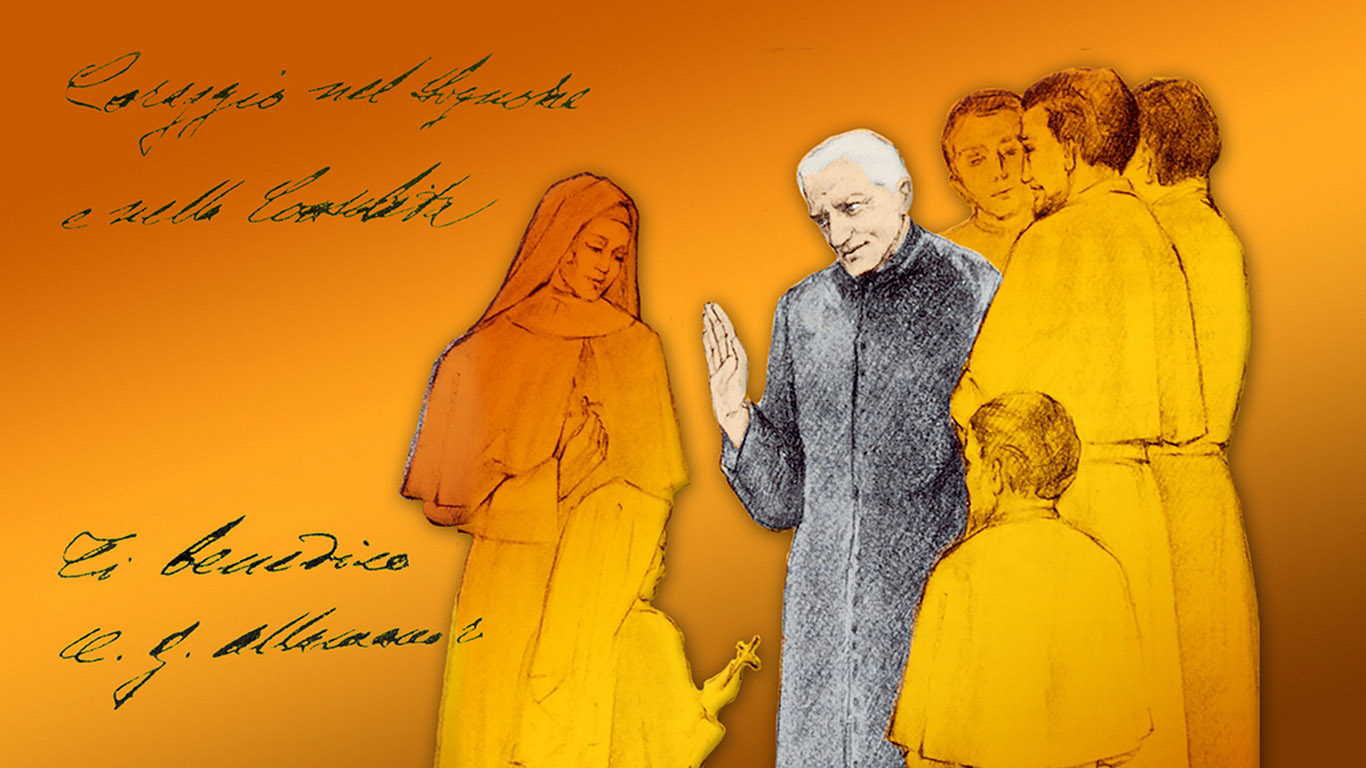
INTRODUCTION
When the proposal to publish a book which would contain only the letters written by the Blessed Joseph Allamano to all his missionaries was submitted, first to the IMC General Council, and subsequently to the MC General Council, I was perplex. I knew that Fr. Candido Bona had just completed his monumental work of gathering and critically publishing all Founder’s correspondence, and so, the proposal, at first came across to me as a duplication and nothing more. But then, I also became aware that collecting and publishing only the letters addressed to the missionaries, and leaving aside the critico-historical references, would make the reading easier, and thus become a meaningful spiritual help for many of his missionaries who had never read them. When I added the conviction that this new book would become a tremendous help for those directing or involved in basic and permanent formation, because all the missionaries would have the chance to come to know directly and clearly all the dynamics used by the Founder in his written relationships with them, I approved the project wholeheartedly.
As soon as I received the printed volume of the letters to the missionaries, I decided to read them all, and with special attention. I must confess that, right from the beginning, I was impressed by the finesse of the Founder’s formative style, his method of helping his sons and daughters in the difficulties they shared with him, in their request for personal help, in the opening of their hearts and soul to their Father, who listened to them with affection, prayed for them constantly, was prodding them to grow in their performance, and also admonished them against the dangers of life and the deceptions of the evil one.
As I was reading this correspondence of Allamano, the thought of doing some research and prepare a brief study on his formative pedagogy as it is revealed in the letters to his missionaries became stronger and stronger. I talked with some of my friends who have a deep knowledge of the Founder and even with my own sister, who has been working side by side with Fr. Candido Bona for several years and by sheer osmosis and with a perceptive heart has developed a fairly good knowledge of the Institute and the Founder. I was encouraged by all to continue the research and conclude the study.
Before I left Rome for Kenya, I developed a research scheme of work. I submitted it to the same friends who critiqued it, made some changes, and enriched it with their own ideas. As soon as I arrived in Kenya, while I was waiting for my assignment by the new Regional Council, I had time to re-read the letters and begin my research according to the scheme I had worked out. I must confess that this second reading of the letters has stirred up strong emotions in me, and has confirmed the convictions of the missionaries who had the Founder as their only teacher and guide in their formation. I felt that they were sharing with me as they did at Mathari, in Kenya, during my first appointment, in Iringa during my visits, and in North America: he was a father capable of tender but also demanding love; he would fully understand the persons, and sympathize with them, but never allowed short cuts in formation; he would forgive their weakness from the heart, but not allow for many falls: he would point at the right way and means for formation, but expected a prompt response and energy in their practice. The personal comments and memories of our elderly missionaries accompanied me while I was doing the research, and most of the time corroborated my findings.
Now I am happy to offer this brief study to all the Consolata Missionaries, and, in a particular way, to those men and women who are engaged in basic and ongoing formation, and who strive to continue Allamano’s formative pedagogy as they endeavor to prepare new missionaries by living with the young candidates, day in and day out or to support the progress of the older ones through their correspondence.
May this study confirm the formators in their hard task to prepare missionaries according to Allamano’s style, and remind them that all the aspects of his own formative process must continue in the present. Let the young candidates be open to a formation which, though it always and everywhere remains very difficult, nevertheless, cannot abandon the elements proposed and practiced by the Founder, even if, at times, they may create confrontations and demand serious efforts on the part of all. Let those who are urged to continue their spiritual journey through ongoing formation, which Allamano practiced extensively through his correspondence, learn to hear the voice of his successors and representatives inviting us to continue to grow, even through admonitions and corrections of their style of life and work, as the Founder was expecting from his own sons and daughters.
It is my conviction that in this formative process, Allamano was directed by a soul and spirit with which he was imbued and which characterized all his activities in the field of formation. A soul and a spirit which were outwardly manifested in qualities, virtues and attitudes of life almost tangible in his letters to the missionaries. If these were practiced at present, as he did in his own times, he would be reassured that his missionaries lacked nothing in the field of formation, and all would be able to keep alive their formation according to his spirit. These are the three major points of this research and study. I consider this study the beginning of a reflection to be continued together by young and older missionaries, by formators in basic formation, and those responsible for ongoing formation, so that all may continue to follow his example in this field.
THE SOUL OF THE FOUNDER’S FORMATIVE PADAGOGY
The soul of Allamano’s formative activity of Allamano consists of four elements: the conviction that his letters are an irreplaceable extension of his pedagogy, that this activity is more religious and spiritual than social, that he alone is the sole representative of God and of Christ in the formation of his missionaries and, as a consequence, he carries the first responsibility for it, and those who cooperate in formation have to make reference to him alone, and are meant to carry out his own instructions.
Let us briefly develop these four points, so fundamental for Allamano and for us, always making reference to his letters.
The correspondence as a continuation of his role as father, founder and formator
Allamano is fully aware that he lacks the time and the opportunities to be constantly present during the basic formation of the candidates and, even less, the ongoing formation of the missionaries in the field. His many activities demand time and energy, and do not allow him to remain with the future missionaries as much as he would like to, and, even less, those who leave the Mother House for the missions. In this second case, he is also aware that he lacks the direct experience of mission, and so his role as formator is even more limited and depends heavily on their correspondence which permits him to know the real situations and difficulties of missionary life, and offers him the possibility of formulating personalized answers as well as concrete and relevant policies for all the missionaries. But, above all, he feels very strongly that he is the father, the founder and the formator of his missionaries, and feels compelled to do all that is possible for him to continue his role of accompanying in the best possible way the spiritual preparation and the growth of all his sons and daughters.
These two convictions of the Allamano give a special orientation to his pedagogical work and the strength to find all possible ways , especially correspondence, to impart it to the missionaries within their context of mission. How could he be the Founder, if he did not have the chance, even though very limited by all his activities, to clearly propose to them his project for a missionary spirituality, a religious and missionary life? How could he be their father if he did not have the chance to accompany his sons and daughters, scattered in Italy and Africa, as they seek to resolve their difficulties? How could he claim being the formator if he did have the chance to live close to his students in Italy, with his missionaries through correspondence, and did not enlighten his collaborators and missionaries as to the principles and fundamental criteria of his formative plan?
Father, founder and formator: three titles which highlight the importance and the special role of a person, and require a great sense of responsibility towards the best possible outcome. Allamano accepts his responsibility to its deepest consequences. It is for this reason that he devotes so much time and effort to the correspondence with his missionaries. His letters will make all this perspective clear to the readers.
He truly feels he is father: and discharges his formative duties with a style corresponding to this reality. He calls Bro. Benedetto Falda “My son in O. L. J. C.” (19)[1]. He seriously admonishes the student, Giacomo Cattaneo, “as superior and father”(39). When writing to all the missionaries in Kenya and other mission territories, he uses the following expressions: “Most dear sons (59, 66, 76, 100, 112, 353, 524, 563); to the missionaries on military service: “Most beloved sons in the Lord,”(327, 330, 363). In joined letters to the men and women missionaries he writes: “Most beloved sons and daughters”(562). With the Consolata Missionary Sisters, but more rarely, Allamano uses the term “figlie” (daughters): “My dear daughters” (141), or “Dearest daughters” (147, 523). At times, he uses the term “daughter” but in the phrase: “My dear daughters” (408). But his fatherhood is expressed in the term, “dear” and “dearest”, both in the singular and in the plural, which he repeats many times as we shall see later on in this study.
One of the most moving expression of his fatherhood is found in the letter which Allamano wrote to his missionaries, after the centennial celebration of the Consolata Shrine. “If your brothers, the seminarians, have in the past few days, taken pride in representing you at the feet of our Consolata, I made it a special duty to do so myself. I left aside, so to speak, all the other titles in order to be present as the father of this new family, and, as such, I offered you all, and each one of you in particular, to this Good Mother….”(59).
Besides being the father, Allamano was deeply aware of his role as Founder, the person called by God to establish the Institute, and on whom the God had bestowed the spirit of the foundation. He, and only he, has this vocation, this mandate. All the others are asked to complement his role, to help him in the implementation and application regarding all the aspects of life and mission, but only if they remain faithful to him. If they depart from his inspiration as the Founder, their actions will damage more than help the Institute and its members. In virtue of this special call from God and consequent role in the Institute, Allamano feels the responsibility to nuance the charism he has received, to impart directives to all his collaborators, and on all its aspects, for an accurate realization; and, at times he corrects them, even using very strong words, when he becomes aware that his charism is not lived as he thinks it should. This last aspect will become clearer as this study unfolds, but for the moment, we shall do with the presentation of a few general observations and quotes from his letters, which refer to this point with absolute clarity and conviction.
The greatest number of his letters were written to Fr. Umberto Costa, the superior of the Mother House and formator of the first vocations (42 letters), to Fr. Tommaso Gays, first religious superior of the missionaries in Kenya (41 letters), and to Mons. Filippo Perlo, the second superior of the same missionaries, the first Bishop of Kenya and Allamano’s first successor in the running of the Institute (30 letters). Of those written to the Consolata Missionary Sisters, 23 were addressed to Sr. Margherita Demaria and 24 to Sr. Maria degli Angeli Vassallo di Castiglione, who were the first superiors and formators of the Sisters. This alone manifests Allamano’s intention to continue his role as formator, by providing assistance, through correspondence, to those whom he had assigned to the formation of the new candidates and of those already in the missionary fields.
The down to earth style, and the subjects dealt with by the Founder in his correspondence, are a further demonstration of his belief that he was responsible for the Institute, and the guide as to the basic, as well as the ongoing formation (cf. letters to Fr. Costa: 121, 125, 128, 145; to Fr. Gays: 10, 27, 33; to Mons. Perlo: 35, 44, 48, 49, 50, 295, 368, 464). A memorable sentence contained in a letter to Mons. Perlo, summarizes all his desire as the Founder to see the Institute molded after his principles from beginning to end: “My lively desire to give the last touch to the Institute while I am still alive, is well known to Y. E.” (493).
I would like to conclude this point, touching on an aspect which, I believe, reinforces this idea of Allamano as the Founder of the Institute., If I am not wrong, in his letters he never mentions Can. Giacomo Camisassa using the title ‘Co-founder’, and, even less, does he attribute this role to him, and never mentions it. The most common titles with which he refers to Camisassa are: the “dear V. Rector” (8, 15, 509), “Sig. V. Rector” (4, 368, 374, 385, 386, 388), “Ven.do V. Rector” (507) or only “V. Rector” (8, 11, 20, 27, 29). These titles span a period of time which goes from the very beginning of the foundation, during the 22 years of work in and for the Institute, to the very end of the life of James Camisassa. Actually, the title “Ven.do V. Rettore”, is given to him by the Founder on the day of his death, when he announced to the missionaries that very sad moment. Far from me the intention of passing any judgment on the historical debate as to the same title to be given to Camisassa. The purpose of this digression is only to point out the will and determination of Allamano to be and to remain the Founder of the Institute, and basing this only on the evidence from his letters. I think the fact that Allamano, in the most intimate moments, which are his letters to his missionaries, both men and women, never refers to Camisassa with any other title than the one of V. Rector, is very significant!
Lastly, all his life, Allamano remains the Formator, non only in the Institute in general, but in respect of each missionary, who writes to him, both those of Turin, as well as those in the missions. His influence on the members remains unchanged for the whole span of his life. We will consider this point at much greater depth in the second part of this study, when we look at the qualities used by Allamano in his service as a formator. But here, I would like to stress the fact that he is the formator of formators, of those individuals whom he has appointed to help him in the realization of his formative plan. His expectations of these individuals are much higher than of any other member, he is demanding a great deal from them, and is not afraid of expressing his criticism or lack of satisfaction for their work. A few quotes to confirm the above statement. Fr. Gays asks to be exempted from his role as superior of the first missionaries in Kenya. Allamano tries to dialogue with him, but, even before they reach a conclusion, Fr. Gays informs the missionaries in Kenya of his resignation as superior. The Founder is deeply upset because each decision had consequences for formation, and writes to him: “Your letter of 19th of September has shocked me to no end ….. You write to me that you intend to proceed and announce to all the confreres my favorable consent to your request. I am sure that you neither considered the seriousness of the step which you intended to take, including as regards your vow of obedience, nor the difficult situation you were going to create for the mission community, keeping it without a superior until my letters arrived. By behaving in this way, you put me in an awkward situation and compromised my freedom of deliberation over such an important matter, almost obliging me to accept your resignation without any hesitation” (34). Between the Rev. Borio, “the first prefect” of the Mother House, and the Founder, some tensions arise, as the correspondence clearly shows. Probably, Don Borio was a domineering person, trying to impose his authority. And Allamano writes to him: “Do everything in a gentle way, so that the young people may every day more love their sublime vocation, and do not remain in the Mother House out of fear of being expelled” (29). When Don Borio proposed to the
Founder to have plays organized, he received a negative answer: “I have thought and reflected on your proposal, and it seems to me that, for the moment, we have to drop the idea” (41). Probably the formation at the Mother House was not progressing well, and the Founder writes to Don Borio: “Make sure that there is peace; and forget about the past” (54). After all the Founder’s efforts, Don Borio was dismissed from his role as “first prefect”, because “ he was offering to the missionaries a distorted formation” (211). The Founder complained with Mons. F. Perlo of a lack of information about his missionaries. He requested that “periodically, a report on all missionaries, male and female, especially before their profession” be sent. “Silence is not sufficient for me. This is a strict duty of yours” (348). The complaints raised by the missionaries and confirmed by the Founder in his letter of November 21, 1921 to Mons. F. Perlo make our blood run cold: “A general complaint is that in Africa the fundamental point of the Constitutions, which spells out the responsibility of superiors to provide all means for the sanctification of the personnel, is not taken seriously …… and that Y. E.’s main concern is to overburden the personnel with work, while ignoring them when it comes to the running of the mission stations ….., and that Y. E. is not a father, but a general, who does not care sufficiently for their spiritual well-being, and again that their needs are not met on time … (464).
Correspondence as a predominantly spiritual activity
Correspondence with his sons and daughters is born out of prayer, matures from his reflection while praying, especially in the “Coretto” (tribune) situated on the right of the Consolata picture, and is written in an atmosphere imbued with spirituality. In their letters to the Founder, the missionaries open their soul, share their hopes and deep anxieties, speak of their spiritual journey; those letters are therefore eminently religious in character. The Founder answers with an equivalent opening of his soul, helping them in their growth, exhorting them to avoid mediocrity and to live religious consecration and mission in a radical way. The religious tone of his letters is evident from the opening invocation, followed by a warm salutation and the text itself, which is packed with instructions, advice and spiritual admonitions, and ends with another religious invocation. Let us consider some of these expressions and texts, which make of his correspondence such a religious activity.
The initial invocation most used are: “ W. J. M. J.” (3, 18, 46, 162, 298, 432, 501), “J. M. J”. (6, 20, 21, 29, 33, 42, 44, 292, 366, 444, 512), “To the G. G. of G.” (40, 414), “I. M. J.” (46), “For the Glory of God Alone” (367).
The salutation expresses all the affection of the Founder for his missionaries. The most common are: “Dear” singular or plural, (142, 145, 174, 285, 310, 326, 344, 399, 426); at times he begins with “My Dear Daughters in J. C. (141, 259); or with “Most Dear” in the masculine and feminine, as well as in the singular and plural (120, 121, 122, 133, 137, 204, 207, 238, 259, 288, 291, 297, 317); when writing to all his missionaries he uses masculine and feminine plural “ Most dear all of you” (320), or to all the novices “My dear novices” (557).
The Text of the letter discloses all the inner spirituality of Allamano. When things do not go well he repeats: Fiat Voluntas Dei (Let God’s will be done) (83). When they go well: “Deo Gratias (Thanks be to God) (84). Those who manifest difficulties he asks to “be happy in the Lord …. Consider yourself blessed to suffer something …” (83). When the negative side of our human nature emerges, he suggests: Infirma Elegit Deus (God has chosen the weak ones) to bring about great successes” (95). To those who are anxious about their past life, he often repeats: “Be at peace and do not worry about the past; live in Domino day after day” (74). To those who confess that they are not faithful to their resolutions he recommends “to do every thing coram Domino and nothing evil will happen. Esto Fortis in Propositis! (Be strong in your resolutions!)” (229). To some who are bewildered and dismayed because they must live outside the community he recommends: “Courage to begin with, and live in the world only with your body, while you soul is where your vocation brought you” (325). With someone who is not certain about his vocation says: “Should we make another effort?.... The Consolata inspires me to try once more …”(393), or “be at peace …. Pray to the Lord that he may inspire you and the superiors to know clearly and carry out the Holy Will of God” (401). When something sinister hits the Institute, he affirms: “The Lord has allowed temptation to hit our dear Institute once more” (228). To the novice master who is highly concerned about the behavior of the novices, and their future, he suggests: “Let us leave the future in the hands of God, whose Holy Will we will follow” (421). And to Fr. Gaudenzio Barlassina, who is dismayed by the first difficulties of the mission in Ethiopia, he suggests: “The Lord has said that he will protect those who trust in Him, and to Him relates all their successes: Protegam eum quondam cognovit nomen meum (I will protect him because he has known my name)” (206). When the Founder does not have time to answer all the letters, he does not get discouraged, but “I pray to your Holy Angel to inspire each of you with the answer: listen to him” (155). A short anthology, which demonstrates clearly how the Founder’s correspondence was saturated with religiosity and spirituality, as it endeavors to see everything from a supernatural perspective.
The conclusion and the final greetings are in perfect harmony with the religious nature of his correspondence. The greetings most used are: “In Our Lord Jesus Christ”, or “in O. L. J. C.” (3, 6, 42, 291, 391, 397, 410, 557), or “In J. M. J.” (385), “In J. C.” (387, 389, 400, 401, 419, 549, 554,
562). The most common conclusions are: “Affectionately in O. L. J. C.” or “In Jesus Christ” (194, 261, 281, 321, 326, 408); “Your most loving father and superior” (260), “I bless you” (218, 269), “I bless you in a special way” (323), “ I bless you with great love” (271, 275, 335), “I bless you kneeling in front of the O. L. Consolata” (381, 391), “Pray for me who love you very much” (12).
I conclude this part of the study by giving a quick look at the famous expression of the Founder, which he uses in so many and different ways, but with the same result.: “Coraggio” (48). “Coraggio in Domino” (69), “Coraggio in Him” (243), “Coraggio and patience in Domino” (250), “Coraggio and blessings/I bless you” (409, 437), “Have courage and do not let your faults depress you” (146), “Coraggio as through the vows you accept the total sacrifice of yourself” (149), “Coraggio always, without thinking of the past or the future” (440), “After all, take courage in all difficulties” (534).
Allamano representative of Christ in the formation of his missionaries
Allamano feels very strongly about the absolute priority of Christ in the formation of his missionaries, as well as about his role as Christ’s representative in the foundation and direction of the Institute. Allamano has to operate in the same manner and with the same sentiments as Christ, cooperating with all his energy to this purpose and without any opposition whatsoever to Christ’s formative action in the Consolata missionaries.
This responsibility emerges very clearly in his correspondence, because, in writing to his sons and daughters, he seeks all the means and opportunities to fulfil his role as the Lord’s representative.
Right from the beginning of the foundation, he poses this question to them. In his first letter to the members of the Institute, he does not have any hesitation to expressing this conviction: “Jesus our Lord, will form his missionaries” (3). In his third letter to Fr. Gays, superior of the first four missionaries in Kenya, after asking him to fulfill certain policies for the good of his confreres, he concludes: “Jesus in the Blessed Sacrament will do it himself” (7). In one of his short letters, not published in the book, but added at the end, he repeats: “Let Jesus work and operate in you: vivit in me Christus” (p. 502). When he announced the death of Fr. Costa to the missionaries, he stated: “The Institute is God’s work and the Lord has blessed it with many graces, some of which are extraordinary” (319).
All his collaborators in the formation process must be accountable to Allamano for their actions and, through him, to Christ himself.
Allamano is aware that his role as founder and formator requires a great deal of time and physical presence, and, unfortunately, he has many other commitments to attend to, and, above all, he does not have any possibility of living with his students and, even less, with his missionaries in the field. Owingly this awareness, right from the beginning, he surrounds himself with collaborators in this process of formation. He shows them a great deal of esteem, he makes good use of them, encourages them with tact but also with determination if needed. But in all this, they must keep in mind that they are his helpers, and depend on him in all the process of formation. If Christ is the true formator and Allamano his representative, all the others are Allamano’s helpers and representatives. He decides on the policies of formation, the others have to follow them, to implement them, and never substitute themselves for him. If and when it happens that any of them deviates from his line of formation, or interprets his directives erroneously, he intervenes immediately and, at times, forcefully.
In his first letter to the missionaries in the Mother House, he clearly states: “For the sake of order and of virtue, you depend on the dear Fr. Scassa who, primus inter pares (first among equals), is responsible to God and to me for every aspect of the life of the Institute” (3). When Fr. Gays submits his resignation as superior, Allamano chooses the then Fr. F. Perlo as his replacement. To him he writes that “your most important task is to set up each mission in an orderly manner, for each establishing rules towards their spiritual and material growth; rules which I approve ad tempus and in a provisional way right from now … For the moment I wish that you do not appoint a procurator …” (35). He announces this decision to the members with the following words: “I have appointed dear Fr.Perlo to succeed him (Gays), and I make him superior of the missions, for all matters, spiritual as well as material….. I am certain that all of you …… will obey him wholeheartedly and in all his decisions, as my representative…” (36). And he asks of Fr. Perlo the following program: “Now, as general superior, you will have to explain to me, in greater details, many things which I should know, or it would be useful to know, especially on the success of the confreres” (38). As soon as Allamano receives Fr. Perlo’s acceptance letter, he writes to him: “Your letter from Limuru…. has brought me much consolation, reassuring me as to the execution of my order ….. I agree with you that all the rules must be implemented….Also, over each project, you should appoint a missionary who can function as a real leader. The basic criterion is that he is able to guide properly the progress of the community, regardless the age or other considerations, if it is required for the good of all…. Above all I exhort you to issue orders, to take the situation into your hands and do everything tamquam potestatem habens (as the actual leader), and be sure that I will approve all you propose …. Only one thing I ask of you: not to be too reticent to write everything to me …., from now on you have to learn how to think and judge somehow pessimistically, and write to me what you truly think with all the details behind it” (47). In a second letter, he goes over the same subject: “You must operate tamquam potestatem habens , because indeed you do have such power” (51). In practice, this power consists in following the orders and dispositions of the Founder, who either suggested them, or approved them, and even corrected them! Allamano recommends to Sr. Cecilia Pachner to “adhere strictly to obedience and the community rules, and to follow the will and desires of her Superior, who is my representative, and thus, God’s representative” (210). We can almost trace a scale of representation in the formative vision of the Founder: God/Christ is the true founder, Allamano forms his members but with direct responsibility to God, his collaborators help him and have to be responsible to him, and, through him, to God.
With these remarks I conclude the presentation of what I consider to be the soul of the Founder’s formation, i. e. the basic element which pervades and characterizes it all, and which, however, also requires a style and attitudes from the formators and the formees, for its correct implementation. And to this I am addressing my attention in the rest of this article.
STYLE AND ATTITUDES OF THE FOUNDER’S FORMATIVE PEDAGOGY
In the preceding pages I affirmed that Allamano conceives formation as an expression of his Fatherhood, of his role as Founder and Formator. Normally he carefully balances these three roles in the formation and accompaniment of his missionaries, except when he feels the need to emphasize one of them more than the others, depending on the situations he is faced with. Drawing from his letters to the missionaries, which, in many respects mirror his soul, I will now address the style of formation he imparted to them.
Love and fatherly concern for all and each individually
I am convinced that this is the fundamental attitude of his pedagogy. I will try to develop it in a special way in its several aspects, always using his letters as our source of information.
a) Gratitude for the gifts and general/personal progress
The Founder never ceases to manifest his expressions of joy for the progress of his missionaries. This certainly encounters appreciation from them and the desire to persevere and become better.
Here are some of his expressions of gratitude. “In going over the benefits which the Lord has bestowed on our Institute since its foundation three years ago, and since the beginning of its missionary work a little over a year ago, I feel deeply moved in the depth of my heart and exclaim with the Apostle: “ Benedictus Deus et Pater D.N.J.C., qui benedixit nos in omni benedictione” (Blessed be God and Father of O. L. J. X. who has blessed us with all sorts of blessings…)”(40)[2]; “I thank the Lord for the wonderful success of your assembly in Moranga. I nurture great hopes, looking at the dispositions you have exhibited, and the atmosphere which prevailed in the debates, and appreciate the wisdom of the conclusions …... I approve all the conclusions without any exception, and I wish them to be implemented in all their details” (52): “From the long conversation with Monsignor Perlo, and the expressions of esteem for you …. I did increase, if at all possible, my affection for you, and there were moments in which I cried tears of consolation when I was told of the good spirit which exists among you” (103). Allamano asks Fr. L. Perlo to convey to the “priests, brothers and young students that, in my brief moments of rest with you, I have been well impressed by the good spirit which I observed. Let them continue their commitment to religious piety and perfect obedience. This is the recompense the superiors are awaiting for the many sacrifices undergone” (131). He confesses to the sisters: “I am very much consoled by the good spirit which exists in your holy House, and by the efforts you make to acquire the virtues proper to your religious state of life, especially your intention to follow in the best possible way, the letter of St. Ignatius” (141).[3]
With the individual missionary, Allamano is even more personal and tender. It is sufficient to read the fourteen letters written to Fr. L. Sales to perceive all the attention, patience and interest for his vocation and his small steps forward in his process of his formation4. To Fr. Marchina he writes: “I have received your several letters, and in all of them I noticed your good spirit and also a certain joy and contentment for your state of life, and I literally rejoiced a lot and thanked Our Lady Consolata” (427). He assures Sr. E. Quaglio: “I have rejoiced at the news given to me by your Superior, over your good spirit, your constant desire to achieve perfection in the duties of your state” (435). And to Sr. E. Tempo he confesses with a sense of joy: “it is a grace to know you; take the step; do not ever be discouraged, but renew your commitment, and, with the Divine Blessing you will become a saint” (488). The letter which tops all the others as regards the fatherly love and concern of the Founder, is the one written to Bro. B. Falda on 02-09-1908, (84). The reading of the entire text constitute an example and a big boost for those who have any responsibility for the members’ formation of the two Institutes.
b) Allamano inspires and stirs up motivation in his missionaries
Such an open and honest acknowledgment of the good achieved and the progress accomplished, inspires a great confidence in his sons and daughters, helps them to share all their formative journey with their Father, even their most intimate pains, and allows Allamano to be open and hopeful in their collaboration. Here are some more significant quotes: others will be foot-noted only. He writes to Fr. A. Borda-Bossana: “I have already written the same things to Fr. Gays, and I take this opportunity to repeat them to you because I know that you are enthusiastic in performing your duty. Listen to me who, even absent, know you well and have more experience than you all” (23); he reproaches Fr. Gays for notifying his confreres of his decision to step down as the superior, and at the end of the letter, states: “I repeat to you that I was shocked at this decision of yours, nevertheless you should have no doubt about my unaltered affection and esteem for you, as I am certain of yours for me and the Work we have begun together” (34”). Even in some humiliating situations, Allamano inspires trust: “My first word is one of forgiveness …… Absolute silence over your confidence to me, and all is forgotten for ever. Courage: surgam….; ecce dixi nunc coepi. (I will arise….; I said, I will now begin again). Let us thank the Lord that you did not fall any lower ….. Soon write to console me” (199). He consoles his sons who are serving in the military, and who sound very sad and disheartened: “The feast of the Immaculate Conception is near, and how much would I desire to spend it with my dear sons, as I used to do in the past….. We are very few left here, and we feel like beaten dogs: there isn’t much of a chance to provoke some laughter or some light moments of joy. You and we need a lot of patience, expectantes beatam spem (waiting for the uplifting hope)…… Courage in Domino, who is able to console us and fill our hearts with joy”
(207).[4]
c) Allamano was helped in his formative dynamics by the awareness that he knew his missionaries well
Even from a long distance, Allamano makes decisions on the future of his sons and daughters, the running of communities, admission to the vows or promises, personal moral situations, which even leave one dumfounded. And yet, he feels perfectly secure, and on safe grounds as to their validity. At times, the position he takes is different from that of the local superiors, he proposes means and solutions different from theirs, just because he is sure that he knows the individual members well, and he can afford to act in the way which, to him, seems best. To Fr. F. Perlo, he provides an accurate outline of five new missionaries, and suggests the field of work each of them should be involved (42). Allamano asks Fr. L. Sales to follow his directives without any anxiety: “take courage; it is the devil which intends to upset you: in Corde Jesu (in the heart of Jesus) and that should suffice… Listen to me: relying on my word, continue to receive Holy Communion, as if you had been to confession, and do not think of anything else. Obedience should be your guide” (104). The knowledge that Allamano has of the Consolata Missionary Sisters seems even wider and deeper than that of the men religious. In one of his letters to Mons. F. Perlo he states: “I suffer when I hear from different quarters that some of the sisters do not meet my expectations …… I am afraid that these sisters have had as erroneous formation, as the fathers and brothers had with D. Borio …..At the moment I do not wish to speak of others, but only of Srs. Teresa and Cecilia, who do not live up to their call as missionary sisters …. It is my wish that Sr. Teresa be sent to another mission station, non as the superior, but under the authority of others. She needs this humiliation to come back to her senses …. Sr. Margherita may not yet have all the qualities of a superior: but, at the moment, she is the best suited for that position, and I wish all the others to respect and obey her…”(211). In a letter to Sr. M. Demaria, Allamano sketches out the qualities and defects of some sisters, and gives her specific orders on the way to treat them, which are based on his knowledge of the sisters: “You already know all, or nearly all, the sisters who have reached the missions, or are due to arrive shortly. They have good will, but some are rather childish ….. For your information, know that I have not asked Sr. Luigia to say or do anything in my name. So do not pay any attention to whatever she will tell you in my name, or according to the spirit and the desires of Father. Sr. Maria can fill you in….” (407). When Fr. L. Rosso was elected general councilor, Allamano foreseeing his negative reactions to this election, writes briefly. “I am glad (about the election) ….please do not write words prompted by humility and such, but only words of availability to the will of God” (516)[5].
This knowledge of the Founder as to his missionaries is not a superficial one, but extends to all the aspects of their lives. To keep it up, he urges Sr. M. Demaria: “I wish you to keep me informed of the overall situation of each sister, but also of each one’s specific problems” (202).
It is clear that the first aspect he is concerned about is the spiritual life, the holiness of his missionaries (76, 296, 386, 402, 5579). Often he refers to it as: “good spirit”, “good news”. How many times in his letters to those responsible for formation, Allamano repeats: “I rejoice over the good spirit”, or “I rejoice for the consoling information” about the students or the religious! (128, 130, 139, 140, 141, 157, 158, 222, 262, 291, 297, 299, 335, 385). He urges Bro. L. Bezzone to renew “every day your determination to become a saint; and you should use the means, especially recalling God’s presence and referring all events to Him: you are here for Him” (136). I feel that a sentence written by Allamano to the first Missionary Sisters sums up clearly his preoccupation and desire for missionary holiness: “Let one of your first duty be to become saints, great saints and immediately saints” (141).
The Founder is very much interested in the vocation of his sons and daughters. He came to know that three novices were left by themselves at Limuru. Fearing for their vocation, he writes to Fr. Gays: “They have been all by themselves for a month now! …. It pains me that these novices are left alone” (33). He often mails guidelines to the missionaries in Africa in order to protect their vocation (76, 112, 147, 151, 524). He is constantly close with his recommendations to those missionaries who are serving in the army, to help them to “preserve in its totality their sublime vocation amidst the dangers of the world” (214, 327, 359, 363). To the student E. V. Baldi he confesses: “The news about yourself makes me very happy. There was some fear regarding your natural unsteadiness and exuberant liveliness. Be faithful to your prayers and guard you from worldly friends…. Esto fortis in fide (be strong in the faith). You will be happy if you are able to keep your fervor to overcome dangerous occasions …” (226) and again he writes to the same student: “Your latest letter has brought consolation to my heart …..How many prayers have I offered, how many blessings have I sent your way for the preservation of your vocation, while I at the feet of our Consolata. I was afraid, and during last year, I had several doubts about your moral behavior, or about your religious and clerical spirit. I am comforted …..by the fact that you again find delight in your presence with Jesus on the altar” (223). Allamano asks the Consolata Sisters to keep in mind that “the best consolation they could offer him was to know that they were very happy in Domino, obedient, and full of mutual love” (232).
The Founder takes very much to heart the health of his missionaries. In his first letter to Fr. Gays, while thanking him for the photos he had mailed, he remarked that “in these pictures he had noticed that they looked a little sad, probably due to tiredness? I feel confident that inwardly you are happy …. But, please, do not neglect your physical welfare, for which you should use all the possible means” (4). In his fourth letter to Fr. F. Perlo he writes: “I thank God who gives you the strength and the grace to work for His greatest glory. But, please, use all the necessary care, do not overuse your strength, and do not be over demanding of your health” (20). And he reminds him in another letter: “I was notified by the sisters that you walked all the way from Tusu to Limuru in two days: I beg you not to impose such efforts on your body, and lose your health as a consequence” (52). He often reminds the formators of both Institutes to be very much concerned for the members’ health. “I rejoice to read the good news about the Student Cagnolo, and the improvement of Garrone. The latter should continue the necessary treatment” (117). He is concerned about clothing: “I hope you have received the parcel with heavy clothes for the cold weather” (199); about food: “Regarding food, it is my intention that you use all the possible care ….and if you lack money, do write to me” (222): and about medical situations: “I hope that the Our Lady Consolata will be the best doctor for you, and heal you very soon, without the need for surgical intervention” (224). Allamano pays a personal visit to a doctor in order to “be certain of the validity of his recommendation” (244). The 25 letters written to Sr. Giuseppina Battaglia constitute an loving documentation of his fatherly interest, affection and closeness for the sick missionary sister who certainly finds comfort in it, and help for both her physical struggle and psychological resistance.
Another area of concern for the Founder is the studies and permanent formation of his missionaries. He tells D. Borio that “the deacon Barlassina could skip the spiritual retreat of the community to September: at the moment he could continue his study of the French and English languages, and of moral theology with Fr. Vignoli” (28). He ships books on formation: “I have shipped you the books requested and, with time, the harmonium too will arrive” (135). To Fr. Gays he mails a “book on the saints …. which was a dear reminder of my youth. Together with this, I also mail you the letters of St. Paul with the desired commentary” (89). He assures Bro. L: Bezzone that he “ will provide him with various lives of saints, requested by him, and also for the use of all; but gradually, gradually, so that too much is not spent on one single mailing. This time I have sent you two volumes of the life of St. Sebastian Valfrè; later on, the others will arrive” (136). He notifies Sr. M. Demaria: “I am sending you various books which you had requested; if you need more, feel free to write to me” (202). When Fr. Balbo asked the Founder if he did consider useful the study of botany, the answer was clear: “I have always been happy at your interest in botany, even if I consider it subordinate to mission. That is the reason why I mailed you the book on botany in German, and all the other material you requested” (119). He is very keen on the ongoing formation of his missionaries, and he writes to them: “To provide for you with a complete and scientific set of books which can help you in your missionary life, I need the list of all the books which you already have …. Besides, it would help me also to have the list of the personal books which each of you possesses, so that I would know exactly which I should purchase, thus avoiding sending duplicates” (79). The Founder is adamantly against any mania for studies: “You acted right with student Albertone, and continue to put a brake on this mania for studying” (166). But he is equally adamant in promoting the studies which will be useful in the mission. “It seems to me that there is no point in canceling the daily hour of study of the Kikuyu language. At the moment, there arent’t any other studies being done and, as you say, the students are not very committed to their studies…. Are we helping to grow lazy persons? … (166).
Even money is a topic in his correspondence. He wishes that his missionaries to be given what is necessary for life, and they should be free to ask for financial assistance when they need it. He notifies D. Borio that, when he returns to Turin, together they will “ prepare the religious habit for student Bertrandi and, if the other two students have not purchased theirs, they will provide one for each. It is my intention to provide one for Bertrandi because his parents are very poor; but the parents of the others are well off, and they should take care of it. You should dialogue with them, to find out the real situation, and we shall decide together” (6). Allamano is timely and precise in forwarding the parents’ offerings for their sons/daughters: “Andrea’s brother brought to me L. 100 (a hundred liras) in gold for his needs. I am asking you to give them to him by taking from the common fund, and I will register the transaction in my register” (52). “I have written to Monsignor (Perlo) to give you the sum of five hundred liras which is a donation from ….” (137). He requests one of the students who is leaving the Institute “to write …. in order to obtain the amount of money necessary for his trip home. It should have been brought when they entered ….as we had informed them” (142). He shows a very refined approach when he asks the missionary sisters to ask for money for their intimate needs. He writes to Sr. M. Demaria: “You will request Monsignor (Perlo) for a certain amount of money …. with which you will purchase stamps and whatever is needed for your needs as a woman, as well as those of the sisters. You will keep these expenses separate, and give the report only to me. I will write this to Monsignor: you just ask for it for the personal needs of the sisters” (208). Writing to Mons. F. Perlo about this, Allamano asks him to “grant her, upon her request, a certain amount of money to purchase what is needed by women. She will keep a private record of it, without writing it in the regular financial register” (211). He is understanding as regards the sharing of money, but also very demanding when accountability is concerned. “Feel free to follow the necessary medical treatment, especially the recommended diet: go to Fr. Ferrero for the expenses you have to meet, but give him a report of them” (229). He recommends to the missionaries who are serving in the army to “use moderation in their expenses, and periodically to send a report of the income and expenses to the missionary responsible for the Common Fund. What is left over, has to be returned to this fund” (214).
Mission is definitely an area on which he puts greater emphasis in his formative work. His missionaries have to excel for holiness of life and missionary zeal. Being aware that one of his limitations is his lack of direct missionary experience, he is all the more concerned that he cannot be a “complete” formator. He makes all efforts to engrave in the minds and hearts of all his missionaries the nobility of this missionary vocation. “This vocation lifts you up above the dignity of Christians, of religious and, indeed, of the diocesan priests themselves, who do not have the privilege of making God known and loved by so many people”…” (112). Right from the beginning of the missionary undertaking, he write to Fr. Gays that the students at the Mother House “are my consolation”, but nevertheless he hopes and desires “to form them all good and learned helpers, well versed in science and art” (33). The same priest, who could feel a little turned off because the Founder had corrected him sternly, is requested as a proof of his loyalty, “ with all your heart to assist Fr. Perlo with your advice and cooperation, so that “viribus unitis (all in unison) and always “cor unum et anima una (with one heart and mind), together, you can promote the good of the missions” (34). He writes to Fr. G. B. Rolfo: “I hope that you will continue your holy mission with determination, without being discouraged by the physical and moral hardships, and even less, by the lack of success” (150). In another letter, he writes to the same missionary: “you have been transferred from one mission to another following my instructions: and that is for the good of mission” (192). In a letter to Fr. L. Rosso, he expresses an open condemnation of one of his missionaries, as a clear admonition as to his future behavior: “I tell you right away that your letter has disturbed me considerably, and the only way I can understand it, is to hope that it was influenced by a missionary who is trying his best to cause trouble to the Institute and the missions. But remember that the Institute is the work of God: nothing and nobody can upset it, not even Fr. Balbo” (383).
The Founder is convinced that he is doing his best to provide a well rounded formation for his missionaries. And yet, the results are not always clear. Is it his fault? He is disturbed by this thought! And so he turns to other members of the Institute to help him complete his formation. He asks Fr. Gays to help the confreres and especially Mons. F. Perlo to give a special emphasis in their work for the preparation of local leaders” (137, 203). He turns to Mons. F. Perlo and Sr. M. Demaria and begs them to keep him informed of the general situation, as well as their views in details, of the personnel, not to hide anything, because he “sa fare la tara” (is able to read between the lines): all is useful to him to prepare missionaries who are always better (154, 202, 208, 212, 295). His recommendations to the missionaries for a more meaningful mission, are many and unceasing. He assures Fr. G. B. Rolfo that “the good God will help you always, even when you feel imperfect. Go ahead: I pray for you daily so that you will preserve your good spirit, even amidst the ever increasing occupations” (93). Fr. P. G. Balbo informs the Founder that he will abandon his studies on the soil. Allamano answers with a short lecture on such studies: “I do not have any difficulty that you abandon ad tempus (for a while) this study for the spiritual and material good of the mission. But the reasons you give do not convince me. At any rate …. These studies must be collateral to mission, and should be done during recreation hours and not during missionary work” (98). Finally, he recommends to Fr. Barlassina, who seldom writes, and usually short letters, to “write more often, long and detailed letters, all that you do, your ideas and proposals: we will answer you and offer you our advice. Remember that we have only one purpose: to do good, the highest good, for the sole glory of God” (206).
The death of each missionary, man or woman, makes the Founder very sad and mournful. And yet, he is always able to move from sadness to a higher vision of faith and of loving acceptance of death. Here are some of his comments: “You and your beloved sisters can imagine the great suffering we have shared with your grief over the death of wonderful Sr. Editta. According to our view of things, it did not seem right that the Lord should test us with such great sorrow ….but this was not God’s view. He desired to reward the sacrifice made when she left everything to save souls, and to provide us, so fast, …. a protectress in heaven” (37)[6]. He writes to Fr. F: Perlo on the occasion of the death of the second Cottolengo sister: “ Your last letter brought us the very sad news of the death of Sr. Giordana. The Lord puts us to the test with such premature deaths: let it be for the good of our missions. We need protectors in heaven, and the Lord selects the best, while he has compassion of our young Institute, from which he does not recall any member” (44)…. All of a sudden I received the withering and very sad news of the death of our dear Fr. Enrico Mazon. I leave it up to your imagination to fathom the depth of this very news which marked a very harsh test for our Institute …. May God pay us back a hundredfold with his blessings and graces for our Institute…” (123). When he announced the death of Can. G. Camisassa to the Institute, he poured out the sadness of his heart in these words. “My hand is still shaking, my heart swells up with pain, and my eyes shed bitter tears as I mail you this letter. Our dear Vice Rector … is no longer with us …We thought that his life was necessary for our Institute, and we prayed to our Lady: Consolata to leave him with us … a little longer …. She did not answer our joint prayers. He was ready for heaven! …” (510).
The parents of all IMC and MC members constitute another aspect which Allamano include in his style of formation. He is fully aware of the great sacrifice made by the missionaries when they left their parents, and of the parents when they allowed their children to leave for the missions. He often refers to it in his letters. He makes all possible efforts to let the missionaries know that he is interested in the life of their parents, he remembers them in his letters (4, 12, 21, 46, 67, 83, 84, 234, 236), he forecasts the bliss of heaven for their sacrifice (855), he requests his sons and daughters to write to them frequent and long letters (61), he admonishes them not to disturb their parents with questions related to their mission work (119), he partakes of the sorrow and pain of the missionaries over the illness and the death of their parents and close relatives, and supports them with his prayers and closeness of heart (15, 23, 122, 213, 215). But, in these sorrowful occasions the Founder’s main recommendation is to drive home to the missionaries that, in the Institute they have found a “father” who thinks of everything, provides for everything, and who loves them as a parent, if not more. “This is what I require of you so that I can lead you as a father, although I live very far” (18). And again: “My best wishes to all my missionaries, for whose sake, and no one else’s, I live on this earth” (44); “May the Lord bless all my most beloved missionaries in N. S. G. C.” (58, 100). And finally a sentence which summarizes this role as a father: “Remember that I love you, also, because through perpetual vows, you are my forever son” (120).
d) The tone of his formative style: Fortiter er Suaviter
Allamano’s knowledge of the students and members of the Institute, his gratitude for their commitment to growing in perfection, inspire confidence in him and, in turn, he feels free to invite them to work with even bolder energy for their sanctification, correct themselves with greater determination and face themselves with deeper sincerity and even accept certain awkward and even humiliating aspects of their lives. Allamano always acts kindly, gently, but also energetically and, at times, resorting to frontal confrontation. His letters are a clear witness to this formative style. The following quotes make this style crystal clear, both regarding himself and those in formation. When Fr. F. Perlo is hesitant about accepting the role of religious superior of the first missionaries in Kenya, because he feels inadequate to the task, Allamano suaviter at the beginning of his letter, and then fortiter towards the end, writes: “We reached this decision after a long reflection and a thorough evaluation of all the possible difficulties. So, in your letter you do not say anything new to us. Suitability for the new role comes from the Lord when ad majorem Dei gloriam (to the greater glory of God) the superiors appoint us, and you have to accept this grace wholeheartedly …. Start immediately, with zeal, be ready for a long haul, and not just a short time …. Do not consume your energy in manual tasks and in taxing journeys, but work with the help of all: it is a sign of prudence to be able to involve all the others in the work and in its outcome, even at the expense of some minor mistakes” (42). Allamano sends to Fr. L. Sales, who is frequently beset by scruples and anxiety, words of encouragement but also an admonition: “You must be humble, and not get discouraged. God forgives and forgets; you make up with you fervor and virtue. The superiors love you, do not avoid them and consider their words and decisions negative” (105). To Fr. Costa, who asked him how to behave regarding student Benedetto, who loved music so much he proposes a kind of overall rule on how to make corrections: “Take aside Bro Benedetto and in a loving way, without mentioning the harmonium, correct his behavior” (111). As to Fr. R: Bertagna, who is reprimanding the Founder for divulging rumors on his behavior, his answer is blunt and downright: “The first pages of your letter are a mystery for me. It did not even cross my mind to ask you any such questions. If you shared them with others, you have done it confidentially, as you wrote to me, and so, they did not reveal anything to me, even if they understood you correctly. Now, even without a request from you in which you ask for my opinion, I could examine you in a better way, and judge the situation. But, without any consultation with me, you declare that your perpetual l vows were not made according to the rules, and now you do not feel like renewing them. What can I answer? My only answer is to bend to your final decision …. I do not feel like writing more to you, but I pray our Consolata to bless you” (113). And finally he hands over to Sr. M. Demaria what could be considered the tone of his style of formation: “ Try to be mother to them, always strong, but also kind” (202).
The part of fortiter becomes fortissime when he deals with superiors who, in his assessment, have failed in their role, or with others who are trying to fool him. In these cases the Founder becomes unbending and gives severe orders.
Fr. G. Barlassina, whom the Founder esteemed and loved very much (42), received some very critical letters of his thinking and behavior. Answering one of his letters in which the missionary complains about several things, the Founder states his case first ironically, but then very seriously: “We felt very happy that this was not one of the few rare and very short letters from you, but that you had begun to write lengthier ones… Coming to its content …., we inform you that you do not have any grounds on which to base a certain aversion, which we perceive, regarding lack of detailed information from our side as to what we were projecting”. The Founder objects to his lack of trust in Mons. F: Perlo and makes this suggestion to him: “You should consider yourself blessed to have such a guide and such a support ….All rumors therefore should be banished ….and you should accept with trust what he proposes to you now and in the future…Instead of trying to avoid him, you should find all possible opportunities to approach him” (206). To all the complaints of Fr. Barlassina on the special mission of Fr. L. Perlo to Mogadiscio, and on his style of work which turns off everybody, the Founder gives straight and pointedly answers: “To begin with, we do not find it helpful a possible opposition from you to his mission to Mogadiscio…., the criticism to which you refer in the Institute, to regarding his work behavior, are not new to us: whoever does something good, normally are criticized….Do not nurture any illusion about pleasing everybody for the work you do” (id). Barlassina claims that the Superiors did not offer accurate guidelines regarding the opening of the mission in Kaffa. Allamano answers somewhat disgusted: “We have already told you that we did not intend to offer you precise and accurate guidelines for your apostolate, because we did not know well its context” (id). To the request of Fr. Barlassina of 50.000 Lire, to be spent in the foundation of the new mission, the Founder reacts with total disbelief: “That news has frightened us …. You must reduce considerably the amount to be spent. If we keep spending the way we do now, the Institute could be ruined…. Try to cut down on all expenses…. In fact, if that new mission …. Would truly require the kind of expenses you project, we would be forced to close it. (id). Probably, Fr. Barlassina must have written to the Founder something to the effect that he feel inspired in what is doing. And Allamano answers with some anguish: “You write that you feel inspired in what you do, and you almost appeal to God’s tribunal. My dear, obedience is the surest way of knowing God’s will. And not one’s own judgment and inspirations” (329). The relationship with the missionaries in Kenya surface again. Fr. Barlassina complains because he receives the mail too late: Allamano is saddened by this attitude and reprimands him thus: “The news of the death of …….. reached us also with much delay. If this atmosphere of mistrust and of rumors against somebody in Kenya would come to an end in Ethiopia, things would be much easier and you would receive more and friendlier news from them….. Oh, would that these unworthy troubles cease, and all of you treat each other like brothers! (465). A missionary allowed a woman to live in the house, as if they were married – (perhaps for reasons of residence?), and the news arrived in Turin through one of the missionaries. The Founder is incensed. “Fr. Goletto should not have written this letter, to any of the members, and, much less, to a student. …Therefore I forbid again this practice …. It is unethical to pass of a faked marriage which does not exist, and should not exist. What will be the consequences for the future? ….will you lose all people’s esteem? (465).
The difficulties with another superior, Fr. Gays, began in 1903, shortly after his arrival in Kenya, and continued for a long time, both in Africa and in Italy after his return from Kenya. We have already seen above the difficulties caused to Allamano for having notified the missionaries his resignation from Religious Superior even before the Founder had given his final permission (34). The missionary probably tried so hard to clarify the case, that the Founder writes him a short letter of two lines to stop this process of self-chastising: “I am not offended, but I grief – Forget about everything e let us share equal affection- Help Fr. F. Perlo and everybody else” (43).The missionary’s answer is silence. And the Founder reprimand him with distress and straightforwardness: “I have not received any letter from you in a long time, nor a diary for a longer period of time. I have no reasons to believe that they have been miscarried ….How can I explain this long silence of yours in a matter of such importance and laid down by our rules? You know how much I love you; please, see that you remove immediately this pain which is like a thorn piercing me, and which I am positive I do not deserve” (60). The difficult situation smoothes out. (77). Soon after Fr. Gays asks Mons. Perlo to be relieved of his responsibility with the catechists’ formation. The Founder is notified of this request, and answers with a flat refusal: “The position you hold in the formation of the catechists is one of the most important in the mission, and I cannot be pushed to accept your request” (137). Allamano shows him a growing esteem (203), the missionary keeps asking for forgiveness, and the Founder assures him with a little touch of astonishment: “The content of the letter took me by surprise ….. you keep apologizing and asking for pardon …. Know that we have nothing to forgive you, on the contrary we have to thank you a lot” (345). And Allamano proposes that he take the responsibility of the Mother House (374). Soon after his return, he goes back to the same doubts and gloomy thoughts: “You write to me ‘I do not feel this is my place, I have many things to tell you, ma, knowing that you do not desire to hear them, gives me pain and sadness’. I do not understand these mysterious words …. It seems to me that I gave you all the confidence of a superior and a confidant, I executed thins exactly as you expected, even to the point of postponing my own points of view to yours. …. How can you say that I do not wish to hear you? …. Come on, write everything and in the clearest possible way” (451).
For a long time the relationship between Mons. F. Perlo and the Founder is based on a sincere and profound esteem. The adjective he uses to describe him are a patent manifestation of this esteem. “Your most excellent and loved Vicar” (152), “The respectable Apostolic Vicar” (112), I am most pleased with you …. Everyone here is waiting for your letters” (11), “Everyone loves and esteems you, because you are blessed with many qualities which empower you, with God’s grace, to fulfill all your duties” (47). “I know that Sr. Margherita herself ha a lot of confidence in you” (211). The Founder defends him against the innuendos of the Kaffa’s missionaries (206). But then he began to experience some difficulty with him, especially regarding the smooth running of the communities and the Institute, and moved by the negative reports expressed to him directly by some missionaries. The Founder begins his series of admonition right from the second year of the presence of his missionaries in Kenya. “Your idea of not confronting head on the situations, of being patient, understanding and excuse, squares well with mine. In fact it does not seem possible that these missionaries, who have done great sacrifices, can be accused of ill intentions” (47). These admonitions are repeated periodically by the Founder, until he writes to Mons F. Perlo such a strong, but sincere, letter which has made history in the Institute (464).
The Founder behaves more or less in the same way with some men and women missionaries. He writes to Fr. G. Balbo: “You must have written your last letter in a bad mood. I was not expecting certain expressions from you: I hope they are the fruit of the sad situation, more than of well weighed intention. I ask you to re-read my letter and you will convince yourself that you had no valid reasons for answering that way. …. To write contemptuously that you began moved by obedience, and now you move out for the same reason, is too harsh” (98). Allamano writes a letter to Sr. T. Grosso, which is like a litany of defects: “Your behavior is more of the world than religious life …, your pride leads you to dominate over the sisters …, your disobey and, at times, use even rude remarks …, lack of charity towards everybody, and particular friendship …, disregard the power of your superior to go straight to Monsignor for orders. I do not include here the slanders … Reflect well …, in this way it is impossible for you to continue …., you risk to lose your vocation, and oblige me to take hard steps, which I will do without hesitation” (209).
Welcoming new candidates, but also determined in their dismissal
Allamano is literally driven by he desire to to form holy and well prepared missionaries. The fear that the lack of a missionary experience may prevent him from doing that, terrorizes, but does not discourage him. He knows that he is able to correct this deficiency, at least partially, through the information received from the missionaries who are already in the mission field. From this consideration and hope derives his constant insistence to all his missionaries, to send him information on the situations in which they live, on their personal, communitarian and religious life, detailed description of the external, as well as internal difficulties. He reminds them constantly of this “duty”, which he himself has inserted in the rules, and which should be implemented by each missionary at least once every three months. When someone is not faithful to this, and the are late in sending the information, or write very short letters, he reprimands them and reminds them of this obligation, which for him constitutes a real blessing in as much as it gives him the possibility to fulfill in the best possible way his role as a father, founder and formator. Let us review some of these invitations and reminders which he sent to the missionaries, dictated by the same yearning for a good formation which burns inside his chest, and does not allow him to be at peace with himself.
In the first place, Allamano asks forgiveness for those times when he cannot respond immediately, he is unable to write to each individually, or he is forced to mail answers which are not exhaustive, or non satisfactory even to himself. He writes to Mons. Perlo: “I have no more time to write to you, after having written just a few lines to all my deal missionaries. I will do it, and much better, another time” (45). And to Fr. A. Dal Canton: “I was sure that I had written to you after your profession; if I have not done it, it is not that I have forgotten you, or I have ill feelings for you” (138). He reminds Fr. G: Mauro: continue your correspondence, even if I am not able to answer all your letters.; when I do not write, I recommend you more intensely to the Lord” (233).
He is determined in his request for information. He rebukes very strongly the student G: Cattaneo: “From the time of your arrival in Africa to this very day, I have not received any news from you. You know that the rule requires that each missionary write at least once every three months: why this silence?” (39). Writing to Bishop F. Perlo, Allamano mentions the answer of Cattaneo, with a sense of bewilderment and humiliation for its sarcastic tone. ‘Send me, please, a few ink-pots, some ink and paper, and I will then write often information about me’ ….This is all he writes, and with what tone” (51). The same rebuke is addressed to Fr. Gays, as we have seen just above: “I have not received letters from you in a long time, and no diary for even longer time … How can I explain such long silence about a duty so important and required by the rules?” (60). The Founder thanks Sr. M. Demaria for her frequent correspondence, but he asks for something more: “I wish to be kept abreast of all the news …, without any fear of exaggeration, or of losing the esteem of the Superiors” (202). And he adds two more reasons for frequent communication in a letter to Sr. Maria degli Angeli: “when the good of the community is at stake, there shouldn’t be any room for indifference, but it if your duty to say everything and clearly, according to the supernatural point of view” (354).
Allamano’s great desire to know especially the information which can help him in his ministry of formation, is contained in a complete and very clear way, in a letter addressed to all the missionaries in Kenya, in which he describes what is the diary, what one should not write, or what is necessary to write and why. (59, pp. 73-74). When he invites Mons. F: Perlo to become the religious superior, gives him this reminder: “It is necessary to coordinate well the mailing of the diaries and letters, following our rules. See to it that everyone writes, and writes things of interest” (38). To those who ask to be dispensed from writing the diary, due to lack of time, he answers: “I cannot dispense from this, because this is a very useful rule” (48).
Discouragement and anxiety for the future of the missionaries and Institute?
His letters show clearly that the Founders live moments of deep sorrow and discouragement for the lack of a generous answer to his formative guide-lines from some of his missionaries. To Sr. M. Demaria, who had written to him describing some painful situation of a few sisters, Allamano answers: “I thank you very much for your long letter and the painful information you have sent. Continue to write both what is positive and negative. Write in the presence of God ….. Think that in the sight of God there will be always failings in this world … (208). He writes to Sr. T. Grosso and points out to her the serious shortcoming and weaknesses, and concludes: “I feel downhearted! … I was hoping a lot from you, but I still do not want to give up and feel cheated by you” 209). He shares the same frustration of Mons. F: Perlo regarding the behavior of a few sisters: “ While I provide all the means to instill the true spirit in our Consolata Missionaries Sisters of the Mother House, I suffer to hear from various sources that those in Africa do not come up to my expectation ….When I reflect on the behavior of some Consolata Sisters in the missions, I do not feel happy about the behavior of some of them …. I feel sorry for the lack of religious, and even Christian spirit in some of them” (211). The Founder opens his wounded heart to Fr. G. Balbo, for his poor behavior: “I received you in the Institute when you were a student, treated you always as a beloved son …. It is for this that your behavior in the mission, and your instigating ill feelings among the other missionaries has caused great sorrow in me …. I remember vividly what you said ine day at the Consolatina: “The time will come when we will be the Superiors …. Why set yourself up as a judge, and behave in inconsiderable and strange ways? (404). The behavior of Fr. G. Barlassina and other missionaries in Kaffa saddened him a lot and, almost out of desperation begs them to “stop that wretched habit of criticizing and live together as brothers” (465).
Fear, apprehension for the future of the Institute? There doesn’t seem to be a basis for this. The most crucial time for the Institute was during the first world war 1915-1918. In his letters of that time, especially to the missionaries in military service, one could perceive the apprehension, but never a real discouragement. From his letters, the Founder’s conviction that his two institutions were God’s and the Consolata’s work and not his own, appears so deeply rooted in his soul, as to exclude any possibility of fear for their future. “In whatever situation we are, let us thrust ourselves into the hands of our dear Consolata, so that the fruit of her work may continue to prosper” (35). But with this certainty, he also harbors in the depth of his heart the possibility that his missionaries may ruin, or, at least, deteriorate, his work. In one of his first letters to Fr. Gays he writes: “May God bless our Institution: we have to be very careful that the proverb Multiplicasti gentes sed non magnificasti laetitiam (The Lord has augmented the number of members, but that has not contributed to greater joy). It is up to you to form a strong foundation for the Missions” (22). After the feast of the Immaculate Conception of 191, writes this comment: “ We are very few left, and we feel like beaten up dogs: there is no more cheerfulness. Patience for all of us, while expectantes beatam spem (we wait for better days) …” (207).
What the Founder wrote to Fr. Gays (33) regarding the relations of the IMC with the other Institutes, reflected a mentality linked to the circumstances, the ecclesiology, missiology and the role of the Missionary Institutes of his time. Nowadays, such a way of thinking, as it is expressed in that letter, is no longer admissible, and even it is counterproductive.
Today, our students of philosophy and theology attend studies in special consortia and universities, where members of many other Religious Institutes study, together with diocesan, as well as, lay students of both sexes. The knowledge of each other and the sharing among them even of the private situations of their respective Institutes are a daily occurrence, and, all things considered, a are considered a positive experience. Our missionaries take part in courses of ongoing formation together with diocesan priests, religious of other Institutes and laity. This wider participation is considered very positive and most enriching. Even the General and Regional Superiors are members of national or international conferences of Major Superiors, whose purpose it is to help one another in the deepening of their charisma, and in a better fulfillment of their services. The communal reflection on themes which interest everybody, the sharing of the different experiences, the difficulties and the questions with which each one is faced, stimulate the creativity, give origing to new ideas and cooperation, offer suggestions and experiments, for the renewal of all their charisma, in the respect of their original thrust and fidelity to thei intuitions of the Founders.
The formators, too, are the originators of inter-congregational meetings between themselves and their students, in regards to formation. But, on this and similar experiments, there is the need, especially at the local level, of discerning, together with the other formators and the students, with a critical sense and in the light of each own vocation, what is healthy to absorb and make it one’s own, or to take a certain distance from it
The reason for this statement is due to past experiences. It seems that the students, after such encounters and the knowledge they acquire of the policies or customs of the others, return to their own seminary and report only, or mainly, those impressions, or policies, or proposals which are somehow fitting their own interest, less demanding than the ones of their seminary, more “attractive” because they project less demanding conditions of life, if not economic advantages. In these cases, it would seem to me that the sentence of the Founder taken from the letter to Fr. Gays, should be taken literally. We, and the others, have our own style of life, our traditions, our modus vivendi in our Institute during the basic formation and after. Therefore, if the requests/proposal for change of our students, go in the direction of an authentic improvement of our style of life and formation, they could be accepted and implemented. On the contrary, if they are meant to offer a way of life and formation less demanding or committed, more secularized and bourgeois, the formators must oppose them without compromise. To learn from the others how to do things better is a wise rule; but to copy from the others to become more bourgeois that what we are already, it may constitute a slow suicide of our spirit and style of life, and, finally, of our basic formation itself.
THE SPIRIT AND ATTITUDES REQUIRED OF THE MISSIONARIES
The Founder establishes his formative method on a soul and a spirit, which constitute the frame-work of all his formation. Aware, as he was, that even the most beautiful and holy activity cannot be propagated spontaneously and easily, he enriches himself constantly of certain attitudes and feelings which help him in his pedagogical work, and offer him tranquility for his soul, because are the guarantee that, as far as he is concerned, has done all he humanly could. Obviously, the success in formation, depends, to a great extent, on those who receive it, since they are the irreplaceable subjects of the process itself. Allamano is personally convinced that his missionaries must participate, in a very active manner, to his efforts to achieve the goals of formation. For this reason he requires from them a certain spirit and dispositions as a condition sine qua non (a condition without which there is no possibility of formation. I will describe briefly, because some have been already mentioned above, these attitudes and internal disposition as they challenge the formators and those in formation.
Frequent correspondence and detailed information
In the previous chapter of this study, I have already stressed Allamano’s great desire and constant request as the Founder and Formator, to receive letters and diaries from the missionaries. And so, for them, this desire becomes a sacred duty to execute with punctuality and to offer as much information as possible. When neglecting it, they feel the need to apologize and to ask Allamano’s forgiveness for their lack of responsibility. He writes to Mons. F. Perlo: “The Rev. Bertagna and Benedetto are asking to be temporarily dispensed from writing the diaries because do not have time to do so. I cannot grant that permission, because this is a very useful rule…. You know now my precise intention for all” (48). He also encourages Fr. M. Ferrero, who asks him to write less frequently: “I suggest that instead of making such a bad resolution to write less frequently, you renew immediately the old one to write often and, possibly, long letters. Even if I am not able to answer your letters, I will always rejoice in receiving your information, and I will happy to share with you the few joys and the many sorrows of your life” (212). He also recommends to Fr. G. Mauro: “Continue your writing to us, even if I am not able to answer all your correspondence: in that case I will remember you with greater intensity to the Lord” (233). In another letter the Founder reveals all his impatience and the desire to receive the confidence of his missionaries: “Your letters are always most welcome; moreover I thirst? for some letters of D. Garrone and student Sciolla” (324). He encourages Fr. L. Sales to write with this fish-bite: “If if was blessing you together with all the others, and seldom individually, after receiving your last letter I have begun to bless you more frequently; see what a reward you receive?” (245). Fr. G. Maletto never corresponded with Allamano, who, upon receiving the first news from him exclaims: “Finally! I and the Prefect exclaimed when we received your first letter! I do not reproach you: but why only a post card?” (247). The Founder keeps pounding and providing more reasons for the fulfillment of the rule. “I am not sure whether I should insist again on the obligation imposed on you by the Rules to write well the diary ….., the majority neglect it …. I only reiterate to you that by neglecting this duty, there will be less and less articles for the magazine, and, as a consequence, to dry out the most fecund source of financial assistance” (76). Another reason for writing: “Your diaries arew well written and delight the confreres of the Institute” (76). He encourages thosewho regularly write, like Fr. Gays, to continue doing so: “Please, continue to write to me because I desire very much to be close to you through your correspondence” (81). He reprimands those who do not write even with severity. “We have immediately rejoiced at the fact that you have begun to write longer letters: I beg you to do it from now on, and more often ….I repeat to you: write more often, longer correspondence and more detailed” (206). Some missionaries in Kenya spread the rumor that those who write often to the Founder, “was an informer” and this “caused less correspondence with me” also because it was said that “the Founder reveals confidential situations which he read in the correspondence”. Allamano admits that he, from time to time, reads “some of your letters to the confreres of the Institute, but not all, and often I read personally only selective paragraphs which build up confidence in them. But, I repeat it again, I never read the confidential situations of individuals, on the contrary, I destroyed all the letters which carried confidential news and matters of conscience” (86). He returns to this topic in a letter to Bro. B: Falda: “Your diaries pleased me a lot …… Continue in this way, with the certainty that you are talking to a father who loves you … and who does not read your letters to others, except those passages which are not confidential” (46). The same message is sent to Fr. A. Borda-Bossana. “Be sure that I am the first one to read your diaries, and only I, and only after I have read them alone, I read or ask others to read what can edify the others, but never what is confidential” (18). He reminds often the superiors of both Institutes of this duty. He writes to Fr. F. Perlo: “It is necessary to arrange better the mailing of diaries and letters, following what the rules state in this matter. You should see that all write and write information which is useful” (38).
Openness of mind, heart and soul, including the most intimate and personal situations
Writing the diaries and describing the mission’s situations are the responsibility of the missionary, required by the rules; and so the Founder has sound ground for insisting on this obligation on the part of the missionaries. To write about personal, intimate and conscience matters is a need more than a duty, and so he cannot insist in this respect and ask for too much. To obtain this goal, he follows another strategy in his correspondence. His usual answers begin with words of appreciation, joy, satisfaction for the general and positive information received, and a special recognition for the more personal ones, as well as for their sorrows, painful situations, moral weaknesses, including even sinful situations. This approach achieves better success than direct references and strong recommendations as to this responsibility on the part of the missionaries. In this way, they are indirectly urged to write, to open up to their fait- father and formator, even as regards the most intimate situations of their souls. Here are a few examples. Fr. G. Balbo had requested the Founder’s “opinion on his conduct”. Allamano obliges and sends an honest appraisal. At the end he concludes: “I hope I have answered the way you had requested” (119). To the opening of the missionaries, corresponds that of the father-formator. The beginning of many letters to Fr. U. Costa, follows the same pattern. “The good news about the Institute makes me very happy” (121); “I rejoice at the good news about the house” (124); “I have read your letter and rejoice at the happiness and good spirit of the dear students” (128).[7] He writes to Sr. M. Demaria: “I thank you for the long and very detailed letter. I am happy at the good spirit which exists in the House” (140); to the Consolata Missionary Sisters of Turin: “I have received your most longer for news … And I rejoiced in the Lord … In a special way I was consoled by the news of the good spirit which reigns in this house, and how you take advantage of all possible help in order to acquire the virtues proper to your state of life” (141). He confided to Deacon D. Ferrero. “For a Superior, it is an intimate consolation when his sons, for whom he spends all he possesses, open their heart to him in confidence. This is also the royal way to religious perfection. I therefore rejoice over what you have written me, or you will share with me orally or in writing” (144). And with student E. Baldi: “I am delighted that you persevere in your daily prayers without counting the cost…”(229). To Fr. U. Costa, who has revealed his most intimate feelings to the Founder: “I am delighted at your holiest sentiments, which are in conformity with God’s designs for your sanctification, and that of the others” (246).
The Founder is a born pedagogue. He knows that his sons and daughters desire to talk with him, reveal and open themselves to him, because they in him their acknowledge their father, founder and formator. They feel him very close and loving. Besides having enshrined in the rules the obligation to write the diary, and describe the situations at the missions, (which are external to the missionaries), Allamano promotes their free opening to him, confiding in him the intimate details of their wounded soul, with a subtlety which does not coerce, or limit, but which opens wide the door of the soul. Trustingly, his men and women religious develop confidence in him, free themselves from heavy burdens, and feel delighted to share with their father, thus offering him an ever deeper knowledge of themselves, giving him the freedom to direct them in their spiritual and apostolic growth with ever growing efficacy. This exchange of personal, intimate knowledge, for many constitutes a true moment of joy and free sharing, while for others it is a burden. As to the first ones, the Founder answers with fatherly solicitude, as to the latter ones with resoluteness, but without closing the doors to a possible change of attitude, which will help them understand the importance of this rule, and practice it for their own, as well as the mission’s good.
Allamano asks for the best from everybody, according to the personal and life situations in which each finds himself/herself
The Founder is not a psychologist by profession, but has a profound knowledge of people and of personalized formative journeys . He does expect the maximum from everybody, but the best each can offer, according to their personal situation. This is a requirement which he proposes with constant insistence; he does not allow half-hearted performance; he wants all, but keeping in mind the individual, and not the group. This desire is expressed by him to Sr. M. Demaria, without any hesitation: “Make it possible for each sister to give all she can in the tasks entrusted to her; in this way we can chart the formation for the future” (202). This is a basic principle of his methodology. And this principle can be adapted to each person and his/her qualities, as well as to the various situations. Fr. Gays is reminded of this principle: “With the expanding of the apostolic fields, as well as the distances, there is the danger of losing that union of minds and hearts which constitutes a treasure for the Institute. There is the danger that a very subtle egoism will creep in, which will weaken the love and concerns for the common wellbeing” (203). He writes to Sr. C. Strapazzon: “With the best of your physical strength you will be even more lively in the mutual spirit of faith and charity, and perfect sincerity” (452). Allamano is fully aware of Sr. G. Battaglia’s illness, and feels like giving her this taxing task: “I approve your reading the books of St. Teresa: they will be of great help in building up your strength and spirit of sacrifice; and these are very essential virtues for missionary holiness …In the meantime, courage, and try to live with your body in the world, while your soul will be where the grace of your vocation has brought you” (325). When the Founder perceives that the commitment is not as desired by himself, he rebukes the missionaries and also himself: “It seems to me that, in the past year, a spirit of fickleness, of morbid inquisitiveness, of distraction and desire for what is new has entered the community…. I blame myself for giving in, with motherly acquiescence, to their requests; but I will steer the group back to the right spirit” (499). He points out many of her weaknesses to Sr. Grosso, and urges her to change: “For a while, now, I have been hearing from various sources sad news about your behavior in the mission. What has happened? At the Mother House you nurtured many desires for change of behavior, getting rid of your defects and becoming holy, and all of a sudden you seem to have forgotten all these resolutions and the many warnings from me to all and to many individually. I sincerely hope that this change of yours may be due to the change of climate, and the type of work you have engaged in” (209). This total commitment, which he expects of his missionaries, at times, finds it hard to become a reality, and so Allamano encourages his missionaries with supernatural thoughts. “Let us accept, for the sake of discussion, that the fruits do not match your hard endeavor; but does this allow you to be disheartened? Always remember that each of us will receive his/her reward secundum proprium laborem (according to one’s own efforts), and not according to the results obtained” (59).
Transparency, honesty and sincerity
Allamano is the person of the Gospel in quo non est dolus (in whom there is no fiction), whose “yes” and “no”, is clear. He himself acknowledges this: “I am sending you the enclosed letter to be read to the Sisters. It may seem a little harsh to you: nevertheless read it in its entirety and to all the sisters. I have thought about it and meditated on it at the feet of Our Lady Consolata” (171). “I have received your letter, and I thank you for its length and all the details. Believe me: it is a false compassion not to say everything in order not to disgust me. The whole truth always, and without amendments, is the best consolation for those who are truly interested in doing good and desire to know things as they are” (155, 208). “As your Father, I will tell you clearly and with total freedom what I think and wish” (153). With Fr. U. Costa, Allamano expresses his availability in formation: “As you know everything”. This transparency became part of his formative methodology, and he was asking his collaborators to practice it. Probably the term ‘transparency’ was not yet included in the pedagogical dictionaries of his time, and so Allamano calls it “sincerity” (8), “confidence” and “his sons opening their heart of his sons” (153), “you speak what you think with openness” (92), “in what you write, all your heart can be read” (67)…., but the substance remains the same. This is a virtue which he requires of his helpers in the work of formation “I have received your two letters, and I find them exactly as I wish: detailed and in conformity with the truth of what has happened” (108); “I have received your most beautiful letter, and I thank you wholeheartedly, especially for the transparency and the details with which you write.. Here, what is at stake, is the good of people, and nobody should fear to hurt me. It would be much more painful if you hid the truth in order not to offend me” (154). To his dear son Fr. L. Sales he confesses: “ I thank you for the information you have sent me. Continue with this method, because you are fully aware of how much I treasure every little information, good or bad, as to our dear Institute” (165). With confidence the Founder seeks the same virtue from all his sons and daughters: “For a superior it is a very special consolation to know that his sons, for whom he spends all he has, open their hearts to him. This is also the royal way to religious perfection. Therefore, I rejoiced at what you revealed to me, and will tell me orally or in writing” (144). In his answer to two missionaries, the Founder declares himself “happy for your confidence; and, as devoted sons, this is what you have to show” (153). And to his most beloved son, Bro. B. Falda : “Believe me, in your writings I can see all your heart, and I love them tremendously” (67); “Your diaries are a joy for me, especially on account of the candor and transparency with which you write them” (46).
Openness to accept the Father Formator’s love even when he corrects and admonishes
Any pedagogical accompaniment requires corrections, admonitions, and even strong reprimands, for the person to grow. Allamano is not an exception to this fundamental aspect of formation, but he does it with plenty of subtlety and the strength proper to a fatherly spirit.
He writes to Bro. B: Falda with complete honesty: “Happy you, to be the first Brother to be admitted to perpetual vows, and thus be the head of a huge crowd of saintly brothers in Heaven. But in heaven, you shall thank me for not having spared you corrections” (84). Fr. Dal Canton was offended because the Founder had not written his congratulations on the occasion of his profession. He considered this lack of acknowledgment, a fruit of his past failures. The Founder writes to him: “I was sure that I had written after your profession; if I have not done so, it is not due to my forgetting you, or my negative feelings against you owing to your past conduct … Dispel any cloud, and do not remember that short delay, which the Lord has permitted, not as a punishment, but as a greater sacrifice before accepting you for ever” (138). To Fr. Gays who has a hard time accepting some corrections from the Founder, and believes that he is offended, he writes briefly: “Not offended, but suffering a lot of pain – Bury the past, and equal love at present” (43). After pointing out to Sr. T. Grosso how serious her failings are: worldly behavior, pride, disobedience, lack of charity, of obedience to the superior and spreading of calumnies, he exhorts her. “get into yourself, in front of the Blessed Sacrament think seriously about your present way of living. Do not accuse others for your failures, but only yourself …. I feel very much saddened, and only your prompt and stable amendment will bring me comfort …I bless you” ( 209). Other similar cases have been considered above, in the section of this article which deals with his strength when confronted with persons who did not obey, or were not honest with him. As can be seen, his method of correcting people of their faults, is based on love and the good of the person. How could one resist such approach? How could a formator do better than this?
Absolute liberty on the part of his missionaries to write to him, even if they have to bypass the superiors’ censorship
Allamano was very close to missionaries residing in Italy, even in matters of conscience, and he soon realized that, once they arrived in the missions, and they were faced with new superiors, they might experience serious difficulties in matters of moral behavior. For this reason he accords them full liberty of conscience, and wants them to write to him with full confidence, even if they have to bypass the rule of sending and receiving letters unsealed, when addressed to, and coming from him. He advises superiors and formators not to open certain letters mailed by him, or to grant freedom to mail to him sealed letters, which the sender considered confidential and reserved only for the Founder. Here are some of his recommendations on this point, addressed to the superiors. He writes to Fr. Gays: “Leave the young missionaries free to write, and seal the envelopes in their presence, so that they are aware that they are free to tell me anything and everything…They need confidence, so they can open their heart, especially in matters of chastity….” (7). And he repeats the same rule regarding confidential letters to Sr. M. Demaria: “I hope that the sisters’ behavior will change, after they have had my letters, which you can read and give sealed to the sisters” … (208). And in another letter he repeats: “You shall hand the letters to the superior open; she can read and give them to Monsignor Perlo who also can read them. But only to me they can mail sealed letters, to the V. Rector, to Monsignor and the Superior” (148). And he reminds Fr. F. Perlo: “I will mail open all the letters to the missionaries, except a few personal ones. You can read the open letters and give them to the addressees if you consider it convenient and opportune, but not the opposite” (47). The Founder complains about a fact which he does not accept: “I know that somebody has written a letter without going through me. This is not good and I forbid it; I do not think that I deserve this lack of confidence” (50). He repeats the same recommendations to the missionaries: “ You will have your private block notes, and every day you can record the feelings of your heart. Be confident that I am the first and only one to read them … I am asking this from you so that, as a father, I can direct you well, even from such a long distance …” (18). He recommends to Fr. G. Rolfo, who had shared confidential matters: “Regarding the confidential matters, and after praying to our Lady Consolata, I urge you to be serene over your past life, to live in Domino day after day” (74). He laments with the missionaries in Kenya that “ clandestine letters are being written” and orders them to “submit them all to the revision of the Superior, Fr. Perlo” (86).
Relations with members of other Institutes
The Founder has written a sentence which, to me, seems important to our study, because, mutatis mutandis (changing what should be changed), it can help our formation in a multicultural context, or damage it altogether. He writes to Fr. Gays: “At Limuru, you will have a greater chance to be in contact with the Holy Ghost Fathers and members of the Government; I want you to deal with the first with kindness; but keep it in mind that their spirit is not ours, and so it is my wish that our missionaries should not mingle with theirs neither in Nairobi, not in Limuru. It is better for us to live by ourselves and, thus, avoid the chance to let them know our petty problems. Moreover, they may have very good customs for their background, but they may not agree with ours, and also they have to adjust to certain facilities and customs which are not convenient to us” (33). This is a long sentence, twisted, lacking good grammar, which shows the Founder’s difficulty in writing on this subject. A difficulty which we will consider in some comments of the last part of this article.
CONSIDERATIONS ON SOME ASPECTS OF FORMATION NOWADAYS
In the light of his letters to his missionaries, the Founder’s methodology, with regards to their training, has aspects that apply universally, whatever the periods, culture and situation, but reveals others linked to his times, and to the mentality of those times. The latter must be understood and accepted only with the necessary corrections and alterations needed, especially as regards the social and cultural realities in which our Institute now functions.
Training for an adequate preparation of formators
It is clear that, the guidance offered during the formation process both at our seminaries and during on-going formation, is both an art and a science, which is strengthened by the witness of a life which is without contradictions and encouraging. As a science, it needs first of all the laying of a sound foundation, in the areas of theology, studied at an academic level as part of the basic formation; then, followed by practical courses to gain experience in the field, and eventually, at least for some, through specialized studies in psychology and sociology, to prepare them to train or help others. As an art, to work of formation has to be felt within; hence, each one brings his own style, and his own unique approach. Both of these, science and art, must be consolidated and made credible through exemplary behavior, which speaks louder than any lecture, which is more convincing than a multitude of concepts, and goes deeper than any formative dynamics, because it is nourished by a holy and dedicated life.
The Founder had a solid theological preparation, an extensive knowledge of both Christian and Religious life, an extremely rich experience of spiritual direction, which give credibility to the formation he left us. He mastered the formative art, which I called “soul”, as it finds its way into the most secret and intimate areas of the human person, to calm stressful situations, remove fear, heal hurts which, at times, accompany the process of formation, instill hope and trust in almost all those to whom he writes, or approach him. His formative skill shines out from the witness of a life which leaves no room for doubts as to what and how he does. On the few occasions when Allamano’s behavior might have given into doubts (such as releasing confidential information contained in letters from his missionaries), he had no difficulty clearing himself and convincing others, as was shown above.
What can be said about the present formation in the Institute? We can say that our formators and those responsible for on-going formation possess a basic satisfactory training in religious/theological studies. Both philosophical and theological formation are carried out in intercongregational study-centers or universities, within easy reach of our seminarians. At two of these centers, the possibility is offered of obtaining a Licentiate or Master’s degree in theology, while the other centers are in the process of offering the same academic qualifications. Our two most recent General Chapters have requested that, when the opportunity arises, all our students of theology are to be given the possibility of obtaining a degree in one of the theological subjects[8].
The vast majority of formators in philosophy and theology, and of the personnel assigned to on-going formation in our Institute, have had a benefit of a time, varying in length, for the specific preparation needed. In most places where our seminaries are located, or where permanent formation programs take place, courses and relevant meetings are arranged for those responsible for formation. In the previous General Council, two of the Councilors were qualified in formation, and one of them is now Superior General. Our formators have frequent meetings: at national level they regularly meet twice a year; at continental level, they meet at least twice in six years, and once at general level. Intercongregational meetings of formators whose students attend the same studycenters, are frequent and very useful for an evaluation of methods, and experiences gained during formation.
Do our formators have a formation “soul” like the Founder? Obviously, they should, as it is clearly described in the Ration Formationis of our Institute. However, we have to admit that this
“formative soul”, by and large, is not manifested with enthusiasm, or is not perceived by the confreres, because, nowadays, formation, already difficult in itself, is becoming a contentious issue. This is evident at every Chapter, every Regional Conference, at Continental meetings, and periodic evaluations…. So that, anyone accepting to serve the Institute in this field, more often than not, does so as a duty rather than a choice, and does his best to find another sector as soon as possible, such as mission apostolate, which is more rewarding and probably less demanding in terms of time, presence and personal degree of commitment.
As regards to witness of one’s life, the “soul” of formation, we have to acknowledge that, in the past few years, there have not been any cases of scandal or sensational defections among those responsible for formation; besides, normally, the students and those missionaries in on-going formation, recall with appreciation and gratitude the time spent with their formators, have a high recollection of their formators, have a high opinion of their formative guidance, and even though their testimony may not rise to the same heights as that given by the Founder, it is, however, held in high regard, and this remains one of the warmest recollection of the seminary years.
Is the “formative dialogue” with the formator possible? Is it desirable?
In our tradition, and in the tradition of many seminaries, there was a clear distinction between the role of the formator and that of the spiritual director. The former was concerned with relationship in community life, discipline, external organization, and with outside contacts, while the latter took care of the spiritual life. The former was allowed to share information about the students, when presenting them for ordination or evaluation; the latter had to keep absolute secrecy, which did not allow revealing what occurred in the process of spiritual direction. Our Ratio Formationis has brought an end to this situation. The formator is expected to concern himself with all aspects of the candidate, including the most intimate and spiritual, to the extent he will think opportune. He will be free to reveal the content of the formative dialogue, of the periodic evaluations of the candidate, in his reports for profession and ordination. Hence, the dread of many missionaries, that the students will not open, and may not feel ready to share the most intimate and negative aspects of their conscience, for fear that this may be detrimental to their future in the Institute.
This is why, many confreres ask that the previous method should be revived. The Founder’s example may assist, though his unique position in the role of formator, and the grace of state with which the Holy Spirit had filled him as Founder, should be kept in mind.
In his letters, the Founder reveals himself as the heart, the mind, the planner of the educational project in the Institute. Almost everything depended on him! He was the one to admit the candidates to the Institute; he it was who advised them to consider other types of vocation, he it was who wanted to be informed of everything, and even without forcing anyone’s hands, managed to do this as regards the candidates, the priests, the brothers, the sisters. We have already clearly seen, previously, the way he managed his relationships with the youth in formation, the missionaries, the superiors and the formators, and how concerned he was in all the aspects of the life of individuals, as they reflected on their future. Some already priests and working in mission lands, were not happy with this method and either did not write, or seldom did so, and then reluctantly. But the vast majority opened their hearts to him, entrusted their thoughts to him, well aware that he would use the information “as a father” and “for their well being”.
Experience has taught me that the two elements that ensure the proper working of the formative dialogue are: honesty on the part of the candidate, and the firm but fatherly attitude of the formator. Those seminarians who have good will, who hide nothing, who truly seek what is for their own well being, are not deterred from sharing everything with the formator, even if they are fully aware that his evaluation and report will eventually affect their future life. This may create some difficulty for them, but not strong enough to stop them from doing their duty. During the period of his basic formation, the candidate who is sincere, is able to share, is honest and straightforward because he knows that this is for his own good. And he can do this with anybody, spiritual director or formator, because there is nothing to hide. But those who have skeletons in their cupboard, or serious faulty behavior, or character defects, are reluctant to share in trust, are incapable of a sincere dialogue with the spiritual director or the formator, and also others with whom they have to deal. There may even be cases where the confessor himself is misled.
Both, in the case of missionaries and students, it must be felt that the one they contact for a formative dialogue, is, so to speak, their father, whose only concern is their real well-being, and the will of God in their lives: a father who is loving and strong, and, above all, anxious to help them avoid harmful styles and states of life, at times psychologically unsound, and also against Gospel teaching.
If these two elements, honesty on the part of the formation candidate and a fatherly attitude on the formator’s part, are present, the formative dialogue will be fruitful, whether done with the spiritual director or the formator; the purpose of formation will be achieved without so mach stress, even in case the dialogue is done with the formator. Actually, the dialogue with the formator towards a decision as to the future of a candidate, or a missionary, will be more fruitful because it is rooted in the real life of the candidate lived and shared by him and his formator.
Excessive emphasis on self-formation?
Another objection raised as regards our formation process, especially in theological seminaries, or in continental gatherings of ongoing formation, deals with the degree of autonomy and self-determination existent in both basic and ongoing formation. Many missionaries feel that our candidates have taken over from their formators, when it comes to decisions regarding the community project of life, decisions regarding practical aspects of life such as the use of money, and the means of communication …. As a consequence, they claim that, by and large, the life of our formation communities shows laxity, discipline has slackened, expenses have increased considerably, the spiritual life has shrunk to its limits, the prayer life mentioned in the Constitutions has all but disappeared, and so basic formation suffers as far as its fruitfulness and depth are concerned. Can the Founder’s pedagogical approach, as it emerges from his letters, throw some light on this, and direct us to clearer directives more in keeping with those of the Founder?
As we have seen above, to be able to offer an all-round formation to his students in Turin and his missionaries in Africa, the Founder endeavored to keep close contact with each of them, and become fully involved in the various aspects and situations of his sons’ and daughters’ lives. He would ask the superiors to write “in general and in detail” on all issues and all members; he also insisted on this with the students and the missionaries themselves. For Allamano, correspondence was an essential source of information and understanding, that enabled him to guide the formation of individuals and communities, to impart precise directives and suggestions, to recall and strengthen attitudes and behavior in conformity with the charism and spirit, and to make available the formation tools best suited to his formation project and his vision of consecrated missionary life.
The Founder was always open to the opinions and contributions of his missionaries, bringing modifications and improvements to some aspects of formation, in the light of the situations described to him. Allamano remained all the time the moving force and the soul of the Institute itself, the fatherly, but energetic person, ever present, ever close, and capable of sharing patiently all aspects of its life. He respected the person of the missionary priest, brother and sister, was always ready to listen, advise prudently, was not authoritative, yet the last word was always his, and it was the decisive word. He made sure his leadership was rooted in listening, prayerful reflection, and advice from reliable sources. His decisions and directives were normally welcomed and followed by the majority of his sons and daughters. Can’t this style of formation bolster formation nowadays? Apart from his unique role as the Founder, which cannot be duplicated, his two other roles, that of father and formator, can still resound positively and meaningfully in the present training methods.
My view is that his spirit can, and must be retained, but some of the practical applications have to change. Formation, nowadays, takes place in situations quite different from those Allamano experienced; on the one hand, formation requires continuity, on the other, alterations are mandatory.
There should be continuity in holding on to the giftedness and attitudes Allamano upheld in his mission as formator, as previously mentioned: a sincere and fatherly concern for each and every one in all aspects of their lives; a permanent, on-going and serene presence, even in cases when resistance could be a reality, and to correspond, could cause pain; intense gratitude for every vocation, but also resoluteness and clear sightedness when advising or encouraging candidates to leave the Institute whenever the required commitment was lacking; courteous openness to the constructive experience of individuals and communities, giving a deeper insight into the spirit and charism; gratitude and appreciation for everyone’s collaboration, without ever failing to meet his own responsibilities, or handing over to others taking control of the formation process. The resulting sacrifices were meant, mainly, to bring about a more lively participation for all in their own formation, not so much as regards their personal lives, but rather their community life. There was to be genuine participation, at all levels, not just at the executive level, as might apply to the Founder. The students and the missionaries themselves were expected to be actively involved in preparing and revising the intended life style for the community, in working out its fundamental options, and the periodic evaluations of the progress made in all its dimensions.
It is clear that the expression written to Fr. Gays as to the relationship of the Consolata Institute with other communities, is to be understood in the light of the situation existing in the Founder’s days, the theology of the Church, and the role of the missionary Institutes in mission territories. It cannot be taken as applicable nowadays as the Founder expressed it; indeed it would work negatively. In fact, our students of philosophy and theology attend classes in Institutes of Higher Learning, as do many others from different congregations. And, all things considered, the contacts are positive. Our missionaries take part in on-going formation courses attended by diocesan priests, religious and lay people, and, here too, the experience has proved enriching and very positive. Our Major Superiors are members of National and International Conferences of Religious whose purpose it is to assist them to fulfill their duties towards the Institute. And their meetings prove a blessing for those Superiors. There is no doubt that the benefits they receive from the programs specifically offered for them, and from sharing informally their experiences, problems, etc., with the Superiors of other Institutes, bring countless blessings, and widen their horizons, propose suggestions on how to solve situations which exist in all Institutes, and open new outlets of creativity for the Religious Institutes, without lacking in faithfulness to the Founder’s charism.
The formators have come across one problem which has to be dealt in their meetings. In their contacts with the members of other Institutes, the Consolata students return to the seminary bringing mainly those situations which appear to favor them, that are more desirable, that are less demanding and offer better chance of less commitment, material well-being, financial advantages, etc. In this case, the Founder’s expression has to be taken literally. We have our own identity, our traditions, approach to life, as an Institute, and as regards formation. If our students request modification that bring about an improvement in our life style, they can be considered and perhaps implemented. But, if they aim at fostering a less demanding, more “worldly” more comfortable life, then the formators must give a resolute “no”, without compromise. It is a wise rule to learn from others, if this brings about improvement; but copying from others so as to become ever more “popular”, “easy-going” could be slow suicide for our spirit, our life style and formative process.
Having stated this, let us ask ourselves: “are the criticisms which I have mentioned above, which missionaries address to the present style of formation, valid”? I feel that there may be grounds for some criticism. Probably in the process of formation of the students, and of on –going formation for missionaries in the field, we have moved from one extreme to the other. Perhaps, some formators allow too much room for a would be “democratic process of formation”. Others are reluctant to face suggestions of those in formation, or they experience a sense of draining and inadequacy, that accompany this particularly demanding service, just to mention a few. I feel that several aspects have to be emphasized without compromise. The Seminary requires a community whose purpose is formation. The young people bring along aspirations and challenges we have to acknowledge, such as the need for a reasonable sense of responsibility and cooperation at all times.
But it is up to the formators themselves to maintain alive the fact that they bear the ultimate responsibility for the formation process, even when this goes against the views of the majority. Besides, I am sure that, if those responsible for basic and on-going formation, make the Founder’s spirit and process of formation their own, and act on this basis, they can enjoy the freedom to alter some formative dynamics, some external aspects of the process, which the present situations demand, and make it more acceptable and fruitful. Obviously all this has to be done in cooperation with the Office of Basis Formation, and the Regional Superiors.
Radical changes?
At times, it is proposed in the Institute, even at Chapters, that there is need for a total and radical change in the spirit, the structures of our formation centers. They do not attribute what they call “failure” of formation, to the formative process, or the formators, the youth in formation, or the Ratio Formationis, but on the system which the Church proposes for the formation to the priesthood and religious life. They point out that, this system encourages the candidates in formation to receive everything, without too much effort; basically not much is demanded of them, yet, at times, there is little appreciation, or co-operation in their response; the young men are passive, rather than active, spectators, not participators, lack initiative, they are on lookers. The academic training they receive does not demand much personal effort, and certainly no financial responsibility. The standard of life in the seminaries is upper middle-class; the differences arising between formators and seminarians often occur in economic matters (pocket-money, outing, going out for a dinner, holidays, trips, mobile phones, etc), rather than focus on issues affecting society, the world of youth; spiritual life shrinks to a minimum; everything is planned and, so to speak, made available by the Institute for the students. These critics claim that this approach cannot help, but fosters a sense of dependence whose outlet is passivity, monotony, boredom, a dull life dragging on for years, without an in-depth spiritual effect on the trainee and his future.
Faced with this situation, it is pointed out that superficial modifications and alterations to the formation process will not bring vitality to its dynamics, but only a semblance of calm within the formation structure. A complete turn about is required in the theory and practice of formation to achieve a dedicated, consecrated missionary life. Radical alternatives are suggested: the seminaries to be abolished, the students to be in small groups, living “among” and “with” the people; the students to defray with their work all or some of the expenses of their daily needs and studies, as many lay students do; to experience what it means to live by the sweat of one’s brow; to find out from experience what it means to work, study, pray and find time for pastoral assistance in the parish and its communities, as many people in the world have to do. The proposed alternative is called “realistic”, not just to “raise smoke screens”; it fosters human, Christian, religious and missionary maturity among the young people. It is claimed that this is an alternative pedagogical process towards the formation of present day religious missionaries, which fosters a deeper awareness of who one is, and owns, in living close to the daily reality of the poor.
Obviously, this is a “dream-formation” still on the horizon. It is an approach to formation which offers some positive elements, but also several negative ones. I feel that, those few congregations, with many members and candidates, that have opted for this style of training (some Franciscans, the Little brothers and Sisters of De Foucauld, and others), have not solved all the present problems of formation, or freed themselves from other head aches. The reality of defections during the formation process, or even after final profession, exists also for them, as well as the conflicts between formators and people in formation, and the tendency towards a less organized life style desired by people in formation.
What would our Founder say about such proposals? A question not easy to answer. Having read his letters time and time again, I feel it is more likely that he would feel more comfortable with our present style of formation, with an emphasis on those aspects of change put forward by the formators and the candidates, previously mentioned , always trusting in the help and light of the Spirit, and the readiness of those undergoing formation to grasp all that is true, beautiful, meaningful, and challenges them to devote themselves wholeheartedly to embody them in their lives.
Having said this, it might be asked whether the Institute is ready to accept this challenge. Obviously it would be on a limited scale, and as an experiment with perhaps one seminary. Of course, what is required, is formators and candidates who fully accept projects such as these, and are working together and courageously facing the initial setbacks, and then giving an honest account to the Major Superiors, so as to evaluate whether to extend it, or discontinue it.
CONCLUSION
It was a delight for me to study the letters sent by the Founder to his missionaries, men and women, and in those letters, hear the voice that still speaks to us, so that, in docility, we are all open to thorough and permanent formation, in sincere cooperation with all those who, in both Consolata Institutes, offer this sensitive service. May they support and revitalize Allamano’s approach to formation without diluting it, without betraying it, and yet making it relevant to the present situations and in agreement with the genuine demands of our presence and the missionary activity of the Church in the world. May the present study confirm the formators in their task to prepare missionaries, both men and women, in the style and spirit of Allamano, and remind them that all aspects of the well thought out educational steps he proposed are relevant, considering the many unethical principles with which young people are being bombarded, especially in the media. Those in training and the missionaries themselves, should be open to a formation that, through an extremely rich and complex process, cannot afford to omit the elements with which the Founder had identified, even though, at times, they give rise to objections, and demand considerable efforts. We are called to continue our spiritual journey through the on-going formation, which Allamano referred to, especially in his letters. I trust we shall learn to listen to the voices of those who represent him, and welcome their call to grow as Consolata Missionaries, even when exhortations turn to rebuke and our life style and mission are questioned, as we follow the Founder’s recommendations.
I am convinced that, into his formation activities with the young and seasoned missionaries, he poured in his own soul and spirit, and imprinted his own mark on all he undertook. This soul and spirit was expressed through qualities, virtues, life-attitudes, which are, so to speak, tangible even in his letters to his missionaries. When put into practice, they gave him peace as he carried out his duties without failing to provide his sons and daughters with the necessary advice and spiritual guidance, to ensure that in all of them, the process of formation, according to his spirit, would live on.
This study is a step in a process of reflection we want to continue together, trainees and missionaries, the better to follow Allamano’s example without fail. I trust that those who feel like adding further reflections and their own suggestions, do so as soon as possible, contributing their views through this same publication, aimed primarily at fostering a dialogue on mission and relevant topics, coming, above all, from our missionaries. Anyone who wishes to correct the stated points of view, or some of the conclusions, should feel free to do so, for the sake of our formation process. May the Founder grant us the grace to keep alive his style of formation, so that holy and zealous missionaries may be trained for the Institute, the Church, the world.
[1] The numbers in brackets are referred to the progressive enumeration of the letters published in the volume: Giuseppe Allamano, Lettere ai Missionary eMissionarie della Consolata, Istituto Missioni Consolata, Torino, 2004.
[2] Blessed be God the Father of Our Lord Jesus Christ, who has blessed us with all sorts of blessings.
[3] Other similar statements can be found in the letters 51, 59, 112, 123. 4 The letters are listed on p. 540 of the volume quoted above.
[4] Similar expressions can be found in letters N. 39, 44, 45, 55, 102, 140, 218, 241.
[5] Other similar letters are N. 51, 56, 126, 128, 129, 199, 484, 487, 499.
[6] The letter was written to Mother Clotaria Arduino, the Superior General of the Cottolengo Sisters who were working with the Consolata Missionaries in Kenya, prior to the coming of the Consolata Missionary Sisters.
[7] Cfr. Letters 130, 139.
[8] Acts of the XIth Chapter, N. 91,2.